Showing posts with label Rye Bread. Show all posts

Wednesday, August 14, 2024

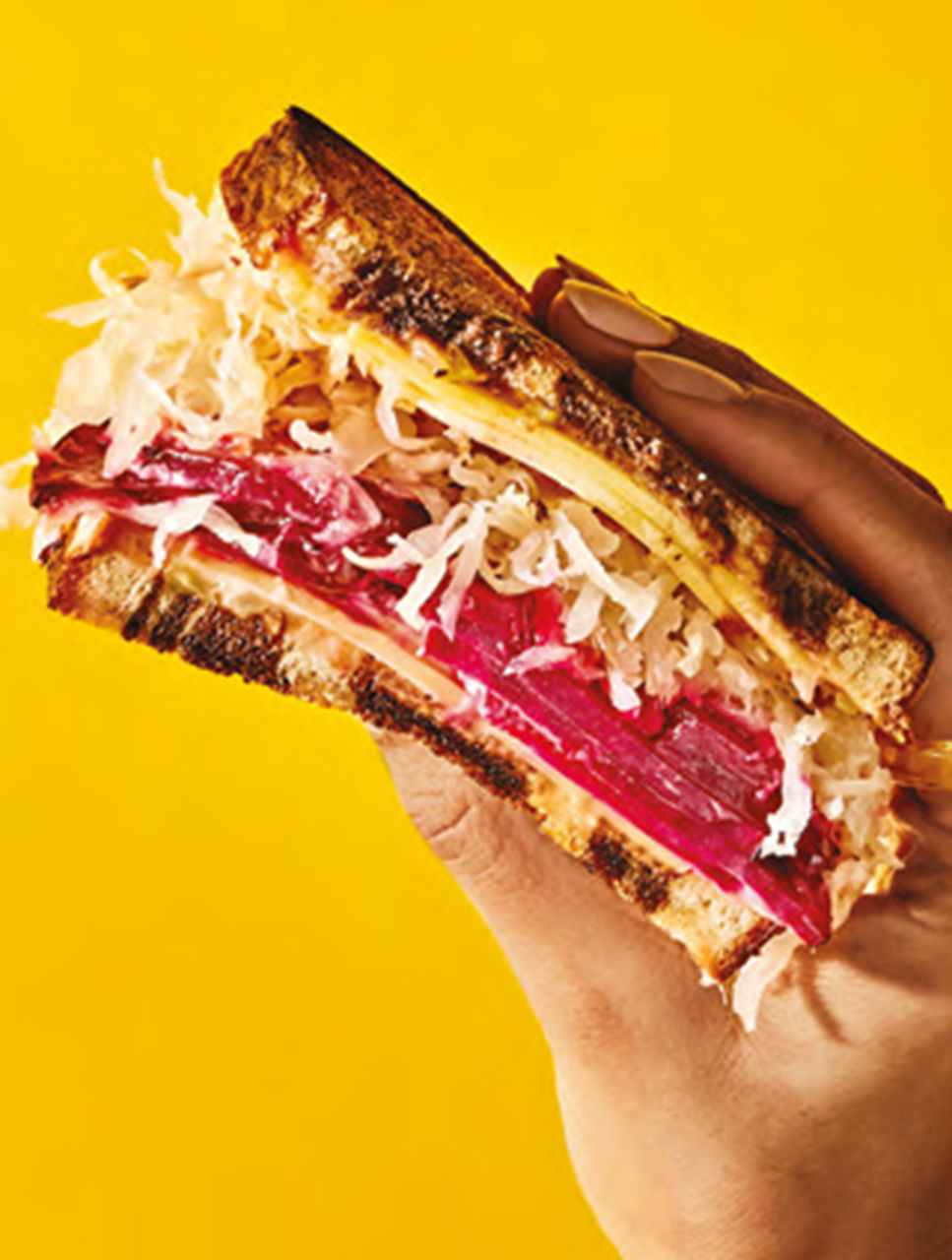
Vegan Beet Rueben

                                                        
Vegan Beet Reuben
Roasted, sliced and spiced beets stand in for corned beef in this delicious meat- and dairy-free take on the classic Reuben. Vegan mayo has become much easier to find—Hellemans version is excellent—as has plant-based “cheese.” Of course, if you’re not vegan, you could use regular mayo and real Swiss cheese.   Serves 4
Ingredients:
Dressing

1/2 cup (125 mL) vegan mayonnaise
1/4 cup (60 mL) finely chopped bread-and-butter pickles
2 tbsp (30 mL) ketchup
2 tsp (10 mL) fresh lemon juice
Salt and freshly ground pepper to taste
Sandwiches
2 large beets, about 1 lb (455 g) total
1 tbsp (15 mL) canola oil, plus more for brushing
1/2 tsp (2 mL) smoked paprika
1/2 tsp (2 mL) ground coriander
Salt and freshly ground pepper to taste
1 cup (250 mL) sauerkraut
8 slices pumpernickel or rye bread
8 slices plant-based Swiss “cheese”

Directions:
For the dressing, mix all ingredients in a bowl until well combined. Transfer to an airtight container. Cover and refrigerate up to 1 week.

For the sandwiches, preheat oven to 400°F (204°C).

Lay out a rectangle of foil big enough to wrap beets. Place beets in middle. Drizzle with oil. Gather ends and seal tightly. Place on a baking dish. Bake until a paring knife inserted in centres meets with just a little resistance, about 1 1/2 hours. Remove from oven and carefully open foil to cool.

When beets are cool enough to handle, peel, trim and slice on a mandoline about 1/8 inch (3 mm) thick. Lay slices out on a baking sheet. Sprinkle with paprika, coriander, salt and pepper. Set aside.

Drain sauerkraut in a sieve placed over a bowl, pressing with back of a spoon to extract maximum brine. Blot dry with paper towel. Set aside.

Lightly brush bread slices on one side with oil and divide between two baking sheets, oil side down. Top each slice with a generous smear of dressing. Top four bread slices with four slices of Swiss, trimming to fit. Divide beets and sauerkraut evenly over Swiss. Top with remaining four slices of Swiss, trimming to fit. Place remaining four bread slices on top, oil side up.

Place two large nonstick frying pans over medium heat. Cook sandwiches until nicely browned and heated through, 4 to 5 minutes per side. (You will need to use a second spatula or a pair of tongs to hold each sandwich together while flipping it. The plant-based “cheese” may not melt, but it will still be warm and soft.) Cut sandwiches in half and serve immediately. Serves 4

Thursday, September 21, 2017

Rueben Sandwich, James Beard,

To make this popular variation, layer the hot meat on twice-baked rye bread, still warm from the oven and slathered with Russian dressing, and top it with Swiss cheese and a scoop of sweet-and-sour coleslaw.  Or you can do as I would and use a panini grill.

Ingredients

  • 8 slices seeded rye bread
  • 2 pounds pastrami, sliced
  • 4 tablespoons Russian dressing 
  • 4 slices Swiss cheese
  • 1 cup coleslaw 

Directions:

Preheat the oven to 300°F. Wrap the bread in aluminum foil; bake for 10 to 12 minutes, until the bread is warmed through.
Meanwhile, to steam the pastrami, bring a pot of water fitted with a steamer basket to a boil. Wrap the pastrami in aluminum foil and place in the basket; cover and allow to steam for 15 to 20 minutes, until all the slices are thoroughly heated.
To assemble each sandwich, spread 1⁄2 tablespoon Russian dressing on one slice of warm rye bread. Add 1⁄2 pound of hot pastrami to the same slice, overlaying the Russian dressing. Top the hot pastrami with 1 slice of Swiss cheese and 1⁄4 cup coleslaw. Spread 1⁄2 tablespoon Russian dressing on another slice of rye bread and place it on the sandwich. Slice in half and serve.

Yield

Makes 4 sandwiches

Wednesday, May 17, 2017

Marble Rye

MARBLE RYE
Makes 2 loaves.
Note: I used Hodgson Mill Rye Flour, but any brand of labeled rye, light rye or medium rye will work. Do not use pumpernickel rye flour; it’s more coarsely ground (from whole rye berries) for a more dense and strongly flavored loaf. Slightly adapted from Fine Cooking.
Ingredients:
For the light dough:
1 3/4 cups (8 ounces) bread flour, more if needed
3/4 cup plus 2 tablespoons (4 ounces) rye flour
1 1/4 teaspoon kosher salt
1 teaspoon instant (quick-rise) yeast
1 teaspoon whole caraway seeds, optional
3/4 cup plus 2 tablespoons room-temperature water, more if needed
1 1/2 tablespoons vegetable oil
1 tablespoon unsulfured mild molasses 
For the dark dough:
1 3/4 cups (8 ounces) bread flour, more if needed
3/4 cup plus 2 tablespoons (4 ounces) rye flour
2 to 3 tablespoons unsweetened cocoa powder
1 1/4 teaspoons kosher salt
1 teaspoon instant (quick-rise) yeast
1 teaspoon whole caraway seeds, optional
3/4 cup plus 3 tablespoons room-temperature water, more if needed
1 1/2 tablespoons vegetable oil
1 tablespoon unsulfured mild molasses 
For baking:
Baking spray or vegetable oil
1 egg beaten with 1 tablespoons water
Directions:
The key to combining the 2 doughs into 1 loaf of bread is to make sure both doughs feel the same when you’re done kneading — that they have a similar texture and suppleness. That enables them to rise at an equal rate. If 1 dough is softer than the other, the loaf will come out lopsided.
To make the light dough: In the bowl of a stand mixer with the paddle attachment, mix the bread and rye flours, salt, yeast, caraway seeds (if using), water, oil and molasses on low until combined. Increase the speed to medium-low and mix until well combined and the sides of the bowl are clean. Switch to the dough hook and knead on medium-low speed until the dough is smooth and tacky. (If mixing by hand, use a wooden spoon to mix and knead with your hands on surface lightly coated with vegetable oil.) If the dough is too sticky, knead in more bread flour 1 tablespoon at a time. If it’s very stiff, knead in water 1 tablespoon at a time.
Spray a medium bowl with baking oil. Form dough into a ball. Place in bowl, then turn over so that all surfaces are coated. Cover tightly with plastic wrap. Let sit at room temperature until doubled in size, about 1 1/2 hours.
To make the dark dough: Immediately after making the light dough, repeat the process to make the dark dough, adding more water if needed to make a dough with the same feel as the first dough. Stretch and fold the dough into a ball and let it rise in another lightly oiled bowl as described above.
To shape the dough: When both doughs have doubled in size, divide each into 4 equal pieces. Generously coat the inside of 2 (8 1/2-by-4 1/2-inch) loaf pans with cooking spray.
Rub a little vegetable oil on a work surface. Using your hands or a rolling pin, gently shape each piece into a 6-inch square that’s about 1/4-inch thick.
Make a stack of 4 dough squares, alternating light and dark doughs. Firmly pat down the stack with the palm of your hand so that all 4 pieces adhere to one another.
Starting with the side closest to you, tightly roll up the stack into a loaf, pinching the seam closed. Repeat with the remaining dough for the second loaf.
Set each loaf seam side down. Gently roll and stretch each until it’s the same length as the pans. Place seam side down in the pans, coat the tops with cooking spray, and cover loosely with plastic wrap. Let the loaves rise at room temperature until nearly doubled in size with tops that are about an inch above the edges of the pans, 1 to 2 hours.
At this point, pressing on the dough with your finger should make a dimple that springs back slowly. If it springs back quickly, give the dough another 15 to 30 minutes to rise.
Preheat oven to 350 degrees and put rack in the center position.
Brush the risen loaves with the egg-water mixture.
Bake for 20 minutes, then rotate and swap the positions of the pans. Continue baking 20 to 25 minutes more, or until the loaves are a rich golden brown and an instant-read thermometer inserted into the center registers 190 to 195 degrees. If under that temperature, continue baking in 5-minute intervals. Underbaking yields gummy bread. To leave a less noticeable hole, insert the thermometer close to the edge of the pan (without touching the pan.)
Transfer the loaves in their pans to a wire rack to cool. When cool enough to handle, remove the bread from the pans. Let cool completely before slicing.
To freeze loaves, wrap tightly in plastic wrap or aluminum foil, then place in heavy-duty freezer bag. Use within 1 month.