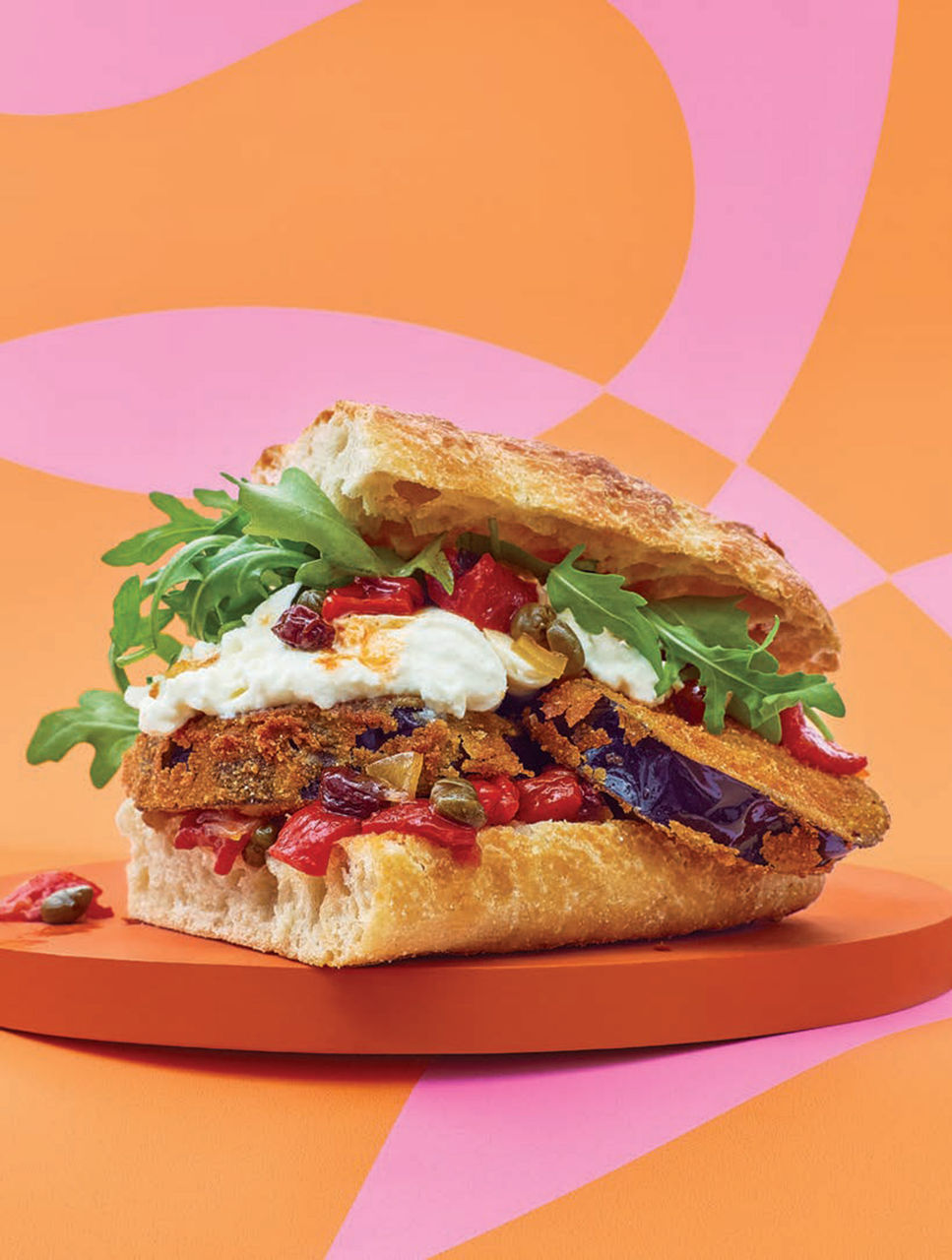
Eggplant And Burrata Sandwiches With Pepper Relish
Eggplant is an excellent vegetarian substitute for chicken or veal to make cutlets for a classic hot Italian sandwich. The crispy rounds are paired with creamy burrata, peppery arugula and a sweet-sour pepper condiment. Instead of focaccia, you could also serve it on ciabatta or crusty kaisers. Serves 4
Ingredients: 1 medium-size eggplant, about 14 oz (395 g) Salt to taste Pepper Relish 4 tbsp (60 mL) olive oil, divided 3/4 cup (175 mL) chopped onion 3 jarred roasted red peppers, drained, cut into 1/2-inch (1-cm) dice 3 tbsp (45 mL) capers, drained, rinsed 4 tsp (20 mL) raisins 3 tbsp (45 mL) sherry vinegar 3 tbsp (45 mL) honey 3 tbsp (45 mL) water 1/4 cup (60 mL) roughly chopped basil
3/4 cup (175 mL) flour 2 large eggs 3/4 cup (175 mL) bread crumbs 4 cups (1 L) canola oil 1 focaccia, about 7 x 9 inches (18 x 23 cm), cut into four, split 1 container (250 g) burrata, drained, quartered 1 cup (250 mL) loosely packed arugula, divided
Directions: Slice eggplant into 1/2-inch (1-cm) thick rounds. Season both sides with salt and place on a baking sheet lined with paper towel. Let stand for 25 minutes.
Meanwhile, heat 2 tbsp (30 mL) olive oil in a medium-size saucepan over medium heat. Add onions. Cook, stirring occasionally, until softened but not browned, about 5 minutes. Add peppers, capers, raisins, vinegar, honey and water. When it comes to a simmer, cover partially with lid and reduce heat to low. Cook, stirring occasionally, until most liquid has evaporated, about 10 minutes. Remove from heat and stir in remaining 2 tbsp (30 mL) olive oil. Cool completely then stir in the basil.
Firmly blot eggplant with paper towel to remove as much moisture as possible. Set aside.
In three shallow dishes, place flour, eggs beaten with 2 tbsp (30 mL) water, and bread crumbs.
In a large heavy-duty pot or Dutch oven, heat canola oil on medium to medium-high heat to 375°F (191°C).
Working in batches, dip eggplant in flour (shaking off excess), then egg (letting excess drip off), then bread crumbs. Fry until well browned and cooked through, about 1 1/2 minutes per side. (Adjust heat as necessary and don’t crowd the pan.) Drain on a baking sheet lined with paper towel.
To assemble sandwiches, lay out four bases of focaccia. On each, place 1/8 of pepper relish, 1/4 of fried eggplant, 1 portion of burrata, another 1/8 of pepper relish, 1/4 of the arugula and top piece of bread. Serve immediately.
These unique dumplings use rice paper as the wrappings, which are rolled into thin cigars then formed into plump twists. The poultry-stuffed parcels are cooked like potstickers and served with a sesame-soy dip. Smaller rice paper wraps are less common, but you can find them under Rose Brand at many Asian supermarkets. Makes about 28 dumplings
Ingredients: Sesame-Soy Dip 6 tbsp (90 mL) soy sauce 1/4 cup (60 mL) water 1 tbsp (15 mL) Chinkiang or regular rice vinegar 1 tbsp (15 mL) toasted sesame oil 2 tsp (10 mL) honey Dumplings 1/2 lb (225 g) ground chicken or turkey, dark meat only 2 tbsp (30 mL) thinly sliced green onions, green part only 1/2 clove garlic, grated on rasp 1 tsp (5 mL) finely grated ginger 1 tbsp (15 mL) soy sauce 1 tbsp (15 mL) Shaoxing cooking wine 1/4 tsp (1 mL) salt 1 pkg (400 g) small (16 cm), round rice paper wraps 2 tbsp (30 mL) canola oil, divided Black sesame seeds and green onion julienne to garnish (optional) Directions:
For the dip, whisk all ingredients in a mixing bowl until honey is dissolved. Transfer to an airtight container. Refrigerate up to 1 month. Bring to room temperature before serving.
For the dumplings, combine all ingredients except rice paper in a large mixing bowl. Mix with your hands until evenly distributed.
Transfer to an airtight container and refrigerate up to 1 day. To form the dumplings, bring a kettle of water to a boil (this will be
used to top up the soaking water to keep it warm). Line a large, shallow
airtight container with parchment. Rinse a clean, small kitchen towel
with water and squeeze dry. Lay out on work surface. Pour about 3
inches (8 cm) of hot water into a medium-size mixing bowl.
Transfer dumpling filling to a disposable piping bag. Tie ends with a twist tie and cut a 1/2‑inch (1-cm) hole at tip.
Working one at a time, soak a rice paper wrap in hot water until slightly softened, 15 to 20 seconds. Carefully transfer to towel. Let sit until water is absorbed and paper is soft enough to eat, 20 to 25 seconds. About 1 1/2 inches (4 cm) from bottom, pipe a horizontal line of filling 4 inches (10 cm) long and 1/2 inch (1 cm) wide.
Roll bottom around filling and roll away from you to form a skinny tube. With scissors, cut off and discard about 1/2 inch (1 cm) from one end. Pinch cut end and roll in on itself to form a twist, pressing end to seal. Place in container. Repeat, topping up with water from kettle as necessary to keep warm, until filling is used up. Continue pinching and sealing ends as they sit in container. Save rest of rice paper wraps for another use. Cover and refrigerate dumplings for up to 4 hours.
When ready to serve, transfer dip to a small bowl. Heat 1/4 cup (60 ml) water and 1 tbsp (15 mL) oil in a large nonstick frying pan over medium-high heat. When it comes to a boil, add half of dumplings, cover and reduce heat to maintain a gentle simmer. Steam for 3 minutes. Remove lid and raise heat to medium-high. When excess water has evaporated, cook dumplings until lightly browned and they reach an internal temperature of 165°F (74°C), about 1 1/2 minutes per side. (If any dumplings unravel, reroll and secure with a toothpick.) Transfer to a serving platter and cover loosely with foil.
Repeat process with another 1/3 cup (80 mL) water, remaining oil and dumplings. Garnish with sesame seeds and green onion and serve with dip on side. Makes about 28 dumplings
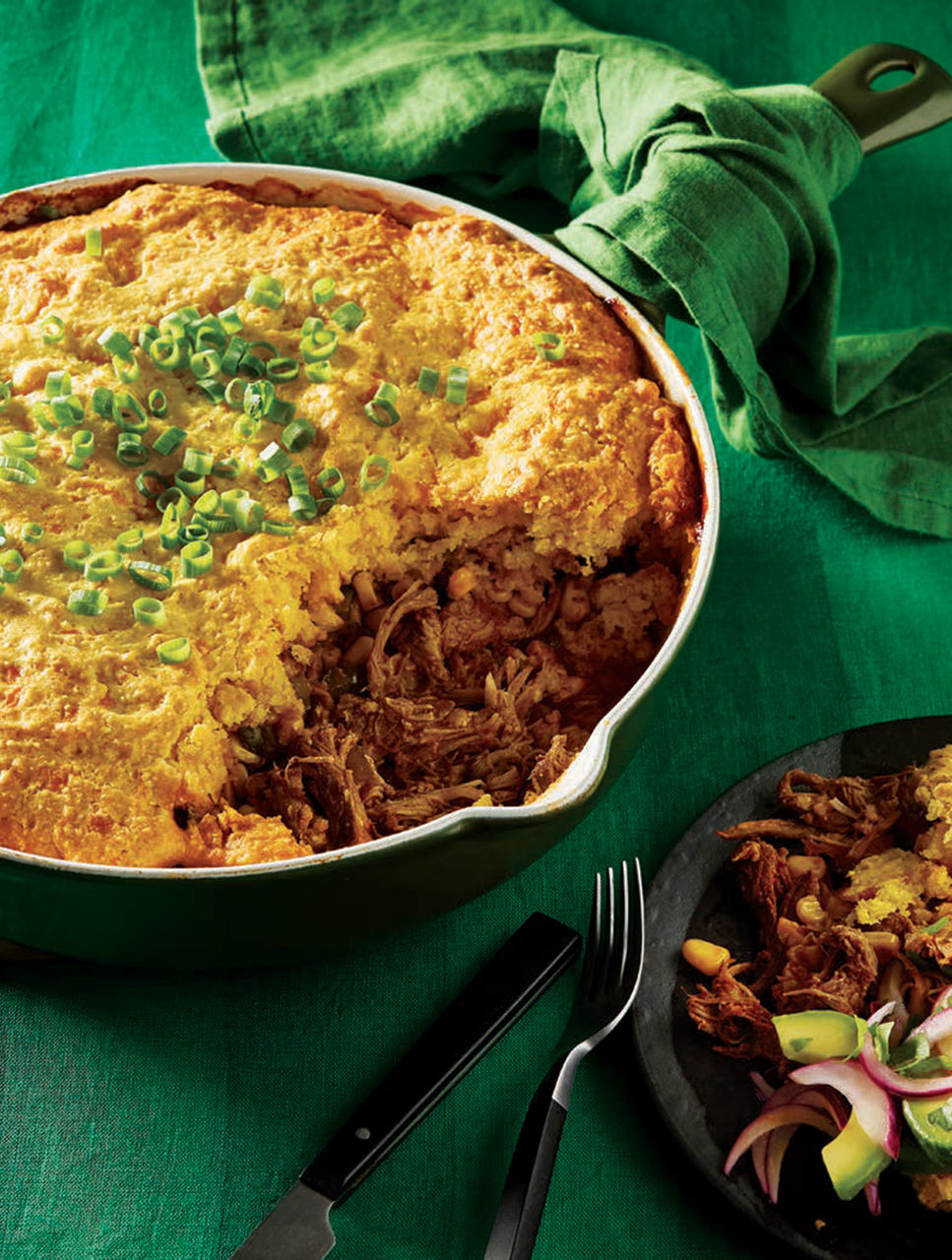
This hearty casserole features rich, slow-cooked pork infused with a complex blend of smoky, fruity and spicy chilies. Baked under a tender, cornbread crust, it’s a deeply satisfying meal. Serve it with a fresh, tangy slaw to balance the bold flavors. Ingredients:
2 medium size dried ancho chilies stemmed, seeded, 3 small to medium-size dried guajillo chilies, stemmed, seeded 4 lbs (1.81 kg) bone-in pork butt roast, cut into 3 large steaks around bone Fine sea salt and freshly ground pepper to taste 1 tbsp (15 mL) canola oil, plus more for greasing pan 1 can (796 mL) diced tomatoes 1 medium-size yellow onion, cut into chunks 4 large cloves garlic, peeled, roughly chopped 1 tbsp (15 mL) cumin 2 chipotle peppers in adobo 1 tbsp (15 mL) packed light brown sugar 1 cup (250 mL) unsalted chicken broth, plus more as needed 2 green peppers, halved lengthwise, stemmed, seeded 2 cups fresh corn 1 bunch green onions, thinly sliced Chopped cilantro, sour cream, pickled onions, and sliced avocado for serving
Cornbread Topping 1 1/2 cups (375 mL) all-purpose flour 3/4 cup (175 mL) cornmeal 1/2 cup (125 mL) sugar 1 tbsp (15 mL) baking powder 3/4 tsp (4 mL) salt 1 1/2 cups (375 mL) shredded extra sharp cheddar 1 cup (250 mL) 2% milk 1/2 cup (125 mL) canola oil 2 large eggs 1/4 cup (60 mL) butter, melted, slightly cooled Directions: Season pork steaks generously with salt and pepper. Using same Dutch oven, add 1 tbsp (15 mL) canola oil and heat over medium-high heat. Working in two batches, if necessary, sear pork until deeply browned, about 4 minutes per side. Transfer to a large plate.Preheat oven to 325°F (163°C).
Drain chilies and place in a blender with tomatoes, onion, garlic, cumin, chipotle, brown sugar and chicken broth. Blend until smooth. Season generously with salt.
Return pork to Dutch oven and pour chili sauce overtop—pork should be mostly submerged; add a splash more broth, if necessary.
Bring to a simmer over medium heat, then cover and transfer to oven. Bake until pork is fall-apart tender, 2 1/2 to 3 hours.
Remove pork from oven. Transfer meat to a large baking pan. Using tongs or two forks, shred meat, discarding bone, extra fat and cartilage. Stir meat back into sauce.
Meanwhile, set oven to broil. Place peppers on a foil-lined sheet pan, cut sides down. Flatten with palm of hand. Broil in top third of oven until nicely charred, about 4 minutes. Flip and broil for another 3 to 4 minutes. Transfer to a cutting board and cut into small dice. Add peppers to pot with pork along with green onions and corn. Stir to combine. Taste and adjust seasoning.
Preheat oven to 350°F (177°C). Lightly oil a 9 × 13-inch (23 × 33-cm) casserole dish.Add enough pork mixture until it’s three quarters full, saving rest (covered and refrigerated) for another use.
For the cornbread topping, whisk flour, cornmeal, sugar, baking powder and salt in a large mixing bowl until combined. Stir in cheese
to distribute evenly. Set aside.
In a medium-size mixing bowl, whisk milk, oil, eggs and butter. Pour wet ingredients into dry and mix gently with a silicone spatula until
just combined- Do Not Overmix.
Top pork with spoonfuls of batter and spread evenly. Bake until lightlygolden and a toothpick inserted in middle of cornbread comes out clean, 45 to 55 minutes. (If edges are getting too dark and cornbread isn’t done, cover perimeter with foil.)
Cool 15 minutes, then spoon onto plates and serve with garnishes, if using. Serves 8
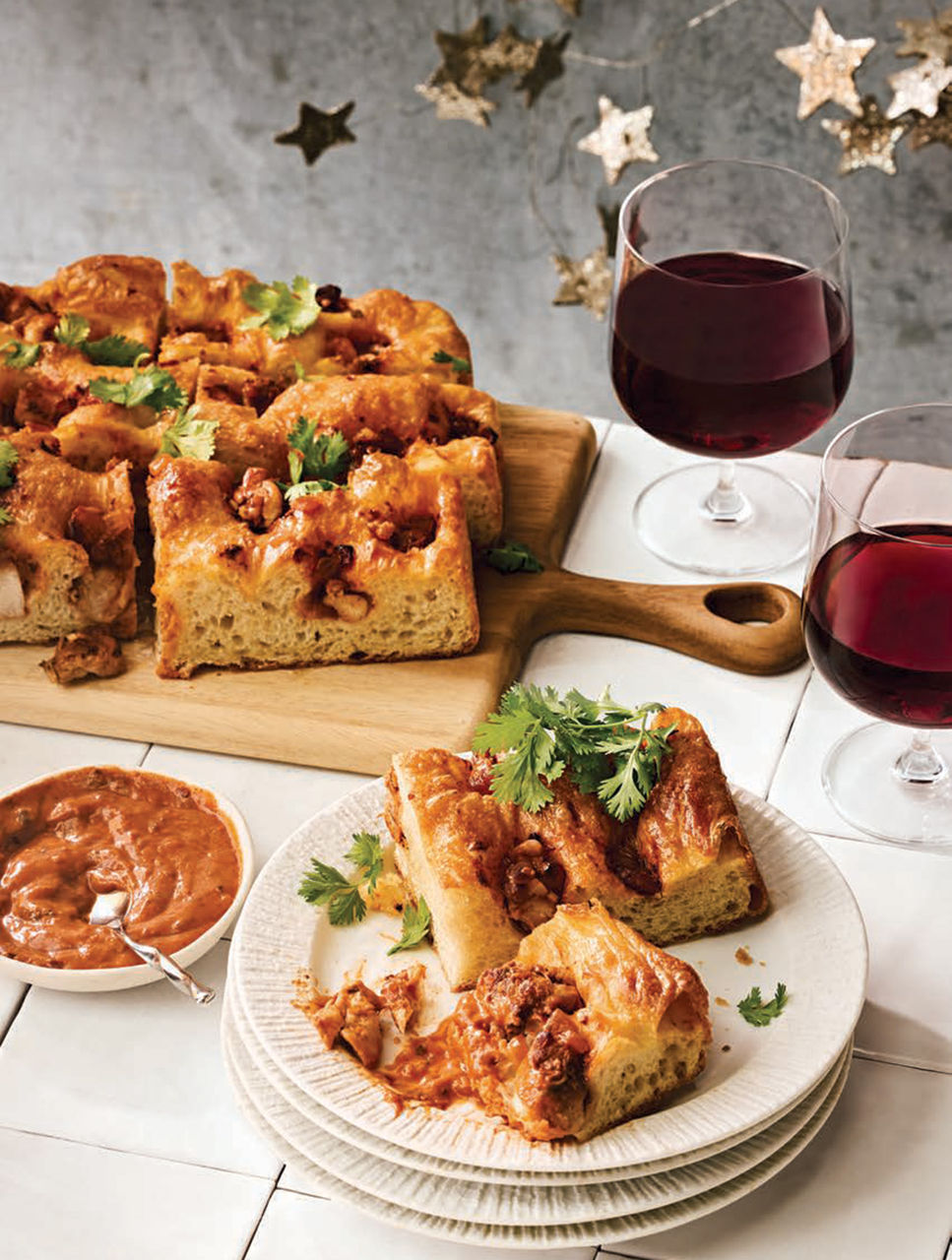
Butter chicken is stuffed into the best focaccia dough, which is slicked with garlicky ghee, sprinkled with cilantro and served with a bowl of extra sauce on the side for slathering. Serve this one hot at your next gathering and watch everyone swoon. This is most delicious fresh out of the oven, but save any extras well-wrapped in the fridge and reheat.
Ingredients:
4 boneless, skinless chicken thighs, about 13 oz (370 g) Salt and freshly ground pepper to taste 1 tbsp (15 mL) canola oil 1/2 cup (125 mL) chopped red onion 1 jar (400 mL) spicy butter chicken sauce, divided 1 recipe (Anything But) Basic Focaccia, completed through Step 6 (recipe follows) 2 tbsp (30 mL) ghee 1 1/2 tsp (7 mL) coarsely chopped garlic 2 tbsp (30 mL) chopped cilantro
(Anything But). Basic Focaccia Directions: This is a very wet dough, which makes a beautifully thick and puffy focaccia with a holey interior—perfect for sandwiches. The series of “stretch and folds” you do while the dough is rising helps to give the gluten enough structure to hold the air pockets. If you’re unfamiliar with the technique, you may want to search online for a visual reference. Do use a scale, if possible, for the measurements of flour and water. Ingredients: 1 1/8 lb (510 g) all-purpose flour (approx. 3 3/4 cups/925 mL) 2 tsp (10 mL) instant yeast 4 tsp (20 mL) Diamond Crystal kosher salt or 2 tsp (10 mL) fine sea salt 14.5 oz (410 g) lukewarm water (approx. 1 2/3 cups/400 mL) 2 tsp (10 mL) honey 3 tbsp (45 mL) olive oil, divided Maldon salt (optional)
Directions: In a large mixing bowl, stir flour, yeast and salt with a fork until combined. Stir in water and honey with fork until all dry ingredients are incorporated. Scrape down the sides of the bowl, drizzle 1 tbs (15 mL) oil overtop, and use a wet hand to fold the dough over on itself until oil has been incorporated and dough feels slightly tightened up, about 20 times. (Dough will be very wet and messy.) Scrape any dough from your hand back into bowl. Cover loosely with plastic
wrap and set aside in a warm spot for 30 minutes.
Wet your hands then grab dough from one side and pull it up and overtop of the dough ball. Repeat this action, rotating bowl so you work all the way around dough until it has tightened up into a ball, about eight folds. Cover bowl,
Lightly oil a metal 9 × 13–inch (23 × 32.5–cm) baking pan. Line with a piece of parchment that goes across bottom and overhangs long sides. (This “sling” makes it easy to remove bread from pan when done.) Pour in 1 tbsp (15 mL) oil overtop and spread to coat parchment.
Wet your hands and loosen dough from sides of bowl. Repeat the stretch and fold action four to six times then tip dough into prepared pan. Fold dough into thirds like a letter, then turn over and rotate so seam is on bottom and rectangle fits pan. Put your hands under dough at corners and lightly stretch to fill pan as much as possible. Lightly cover with plastic wrap and let stand until very puffy and bubbly, about 1 1/2 hours.
Place rack in bottom third of oven. Preheat to 450°F (232°C).
Drizzle dough with remaining 1 tbsp (15 mL) oil. Use your fingers to press down and dimple dough all over—it should now look super bubbly. If you’re baking it plain, sprinkle with Maldon salt, if desired.
Bake in bottom third of oven until deeply browned, about 25 minutes. Transfer to a wire rack to cool. It’s best enjoyed the same day you
Just the thought of a bowl of Oxtail Soup makes me salivate. Recalling my childhood, I was blessed with a mother's great culinary skills. She was raised on a farm and learned with her mother's guidance the art of homemaking. We enjoyed very diverse foods prepared so tastefully prepared, and oxtail soup was one treat!
Ingredients3 pounds oxtail, cut crosswise into 2-in. pieces and excess fat trimmed1 3/4 teaspoons kosher salt, divided, plus more to taste1 1/4 teaspoons black pepper, divided plus more to taste1/3 cup all-purpose flour2 tablespoons canola oil6 ounces thick-cut bacon (4 to 5 slices), sliced crosswise into 1/2 inch pieces1 pound fresh cremini mushrooms, trimmed and cut lengthwise into bite-size wedges1 1/2 cups sliced carrots1 cup sliced celery6 garlic cloves, finely chopped1/2 cup dry red wine1 tablespoon sherry vinegar8 cups best-quality lower-sodium beef broth3 ounces uncooked wide egg noodles(about 1 2/3 cups)1 cup frozen pearl onions2 teaspoons finely chopped fresh rosemary2 teaspoons Dijon mustard Directions:Pat dry oxtail with paper towels then sprinkle all over with 1 teaspoon each of the salt and pepper. Place flour in a wide shallow bowl. Dredge oxtail in flour, and shake off excess. Transfer oxtail to a large plate. Heat oil in a large Dutch oven over medium-high. Working in 2 batches, add oxtail, and cook until browned on 2 sides, 2 to 5 minutes per side. Remove from heat. Transfer browned oxtail to a plate. Clean Dutch oven. Place bacon in Dutch oven. Cook, stirring occasionally, over medium-high until bacon is browned and fat has rendered, 8 to 10 minutes. Add mushrooms, and cook, stirring occasionally, until mushrooms have released their water and are lightly browned all over, about 10 minutes. Reduce heat to medium. Add carrots and celery; cook, stirring often, until carrots are slightly softened, about 6 minutes. Add garlic, and cook, stirring constantly, until fragrant, about 1 minute. Add wine and vinegar; cook, stirring often, until just slightly thickened and reduced, 2 to 3 minutes. Add broth, and return oxtail to Dutch oven. Bring to a boil over high. Cover and reduce heat to low. Cook, stirring occasionally, until oxtail is tender but not falling off the bone, 1 hour, 30 minutes to 1 hour, 45 minutes. Remove from heat. Using a slotted spoon or kitchen tongs, transfer oxtail to a work surface, and let cool 15 minutes. While oxtail cools, skim and discard fat from surface of soup. Separate oxtail meat from bones; discard bones, and set meat aside. You should have about 1 1/3 cups of meat. Bring soup to a gentle boil over high. Stir in egg noodles and onions. Return to a simmer over medium, and cook, stirring occasionally, until noodles are tender, 6 to 8 minutes. Remove from heat. Stir in rosemary, mustard, picked oxtail meat, and remaining 3/4 teaspoon salt and 1/4 teaspoon pepper. Adjust seasoning to taste using additional salt and pepper, if desired. Divide soup evenly among bowls, and serve.
Ingredients
3poundsoxtail, cut crosswise into 2-in. pieces and excess fat trimmed
1 3/4teaspoonskosher salt, divided, plus more to taste
1 1/4teaspoonsblack pepper, divided plus more to taste
1/3cupall-purpose flour
2tablespoonscanola oil
6ouncesthick-cut bacon (4 to 5slices), sliced crosswise into 1/2-in. pieces
1poundfresh cremini mushrooms, trimmed and cut lengthwise into bite-size wedges
1 1/2cupssliced carrots
1cupsliced celery
6garlic cloves, finely chopped
1/2cupdry red wine
1tablespoonsherry vinegar
8cupsbest-quality lower-sodium beef broth
3ouncesuncooked wide egg noodles(about 1 2/3cups)
1cupfrozen pearl onions
2teaspoonsfinely chopped fresh rosemary
2teaspoonsDijon mustard
Directions
Pat dry oxtail with paper towels then sprinkle all over with 1 teaspoon each of the salt and pepper. Place flour in a wide shallow bowl. Dredge oxtail in flour, and shake off excess. Transfer oxtail to a large plate.
Heat oil in a large Dutch oven over medium-high. Working in 2 batches, add oxtail, and cook until browned on 2 sides, 2 to 5 minutes per side. Remove from heat. Transfer browned oxtail to a plate. Clean Dutch oven.
Place bacon in Dutch oven. Cook, stirring occasionally, over medium-high until bacon is browned and fat has rendered, 8 to 10 minutes. Add mushrooms, and cook, stirring occasionally, until mushrooms have released their water and are lightly browned all over, about 10 minutes. Reduce heat to medium. Add carrots and celery; cook, stirring often, until carrots are slightly softened, about 6 minutes. Add garlic, and cook, stirring constantly, until fragrant, about 1 minute. Add wine and vinegar; cook, stirring often, until just slightly thickened and reduced, 2 to 3 minutes. Add broth, and return oxtail to Dutch oven. Bring to a boil over high. Cover and reduce heat to low. Cook, stirring occasionally, until oxtail is tender but not falling off the bone, 1 hour, 30 minutes to 1 hour, 45 minutes.
Remove from heat. Using a slotted spoon or kitchen tongs, transfer oxtail to a work surface, and let cool 15 minutes. While oxtail cools, skim and discard fat from surface of soup. Separate oxtail meat from bones; discard bones, and set meat aside. You should have about 1 1/3 cups of meat.
Bring soup to a gentle boil over high. Stir in egg noodles and onions. Return to a simmer over medium, and cook, stirring occasionally, until noodles are tender, 6 to 8 minutes. Remove from heat. Stir in rosemary, mustard, picked oxtail meat, and remaining 3/4 teaspoon salt and 1/4 teaspoon pepper. Adjust seasoning to taste using additional salt and pepper, if desired. Divide soup evenly among bowls, and serve.
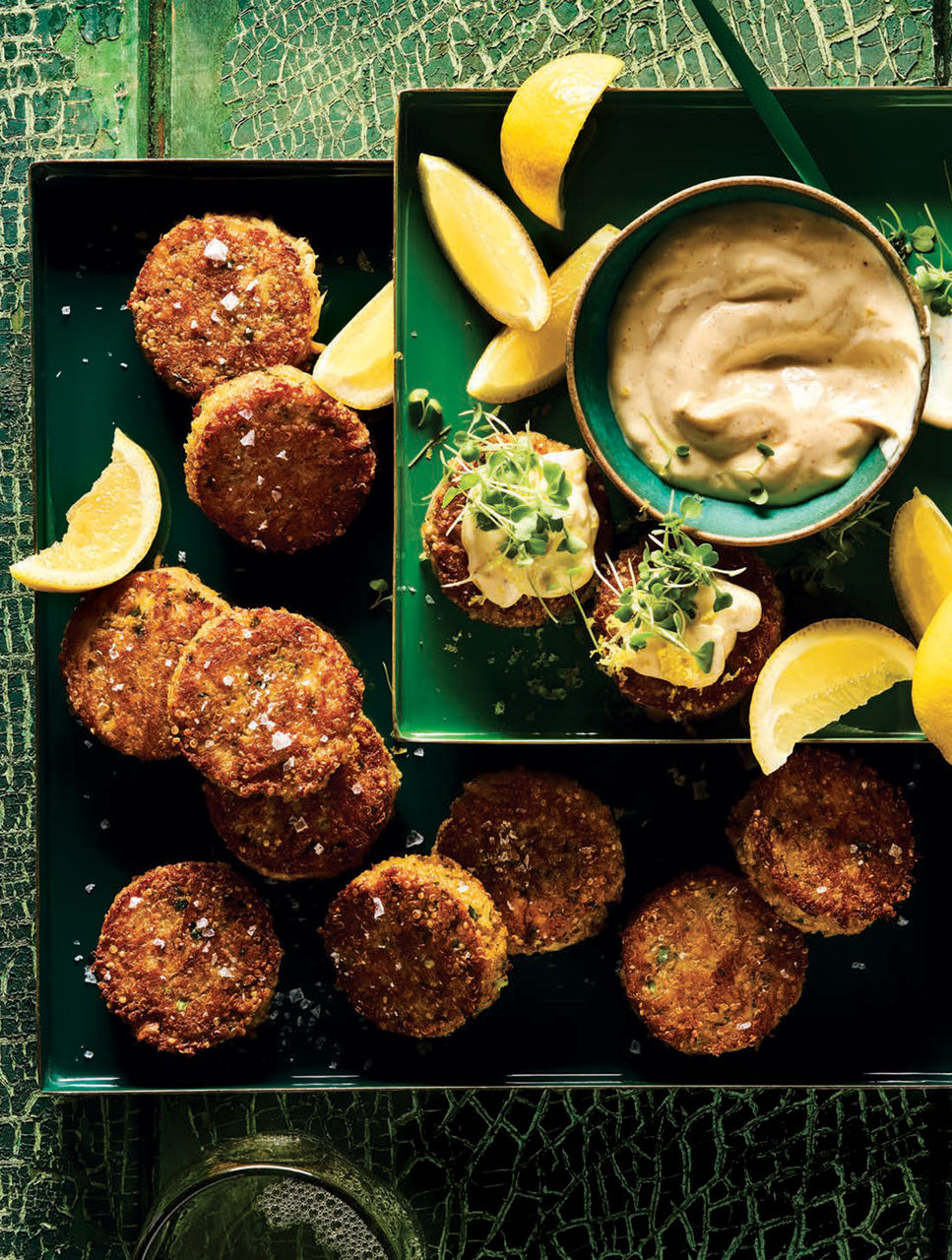
Adding quinoa to crab cakes extends an expensive ingredient and produces an unbelievably crispy crust. Have patience with the forming process—it’s finicky, but it’s worth the effort for the delicate interior texture. Pasteurized crabmeat is sold in the refrigerator case at better fish counters. Makes 32 crab cakes
Ingredients:
Old Bay Mayo 2/3 cup (150 mL) mayonnaise 1 1/2 tsp (7 mL) finely grated lemon zest 1 tsp (5 mL) fresh lemon juice 1 tsp (5 mL) Dijon mustard 1 tsp (5 mL) hot sauce 1/2 tsp (2 mL) Old Bay seasoning
Quinoa Crab Cakes 2/3 cup (150 mL) white quinoa, rinsed 1 cup + 3 tbsp (250 + 45 mL) water Salt to taste 1 lb (455 g) pasteurized crab claw meat 1/4 cup (60 mL) finely chopped celery 2 tbsp (30 mL) chopped parsley 1 tsp (5 mL) Old Bay seasoning Freshly ground pepper to taste 3 large eggs, lightly beaten 1/2 cup (125 mL) panko bread crumbs Canola oil for frying Flaky sea salt to finish (optional) Lemon wedges for serving
Directions: For the Old Bay mayo, whisk all ingredients in a mixing bowl until combined. Transfer to an airtight container. Refrigerate up to 5 days.
For the quinoa crab cakes, rinse quinoa in a sieve. Drain for 5 minutes and place in a medium-size saucepan with water and a healthy pinch of salt. Bring to a boil over high heat. Reduce heat to low, cover and cook for 15 minutes. Remove from heat and let stand 10 minutes. Transfer quinoa to a baking dish. Cool completely.
Transfer crab to a large baking sheet. Spread out and discard any stray bits of shell. Blot with paper towel and cut any large pieces in half. Set aside.
Place cooled quinoa in a large mixing bowl. Add celery, parsley, Old Bay, pepper and eggs. Mix thoroughly with a silicone spatula. Fold in crab and panko, working gently to minimize breaking up crabmeat.
Form loose, scant 1/4-cup (60-mL) portions into patties about 1 3/4 inches (5 cm) in diameter and 3/4 inch (2 cm) thick. (First squish mixture to pack, then hold in a circle formed by the thumb and index finger of one hand and use the fingers and thumb of the other hand to flatten into patties.) Place cakes in a single layer
in large, shallow, airtight containers lined with parchment. Cover and refrigerate up to 1 day.
When ready to cook, preheat oven to 200°F (93°C). Place a cooling rack over a large, rimmed baking sheet. Working in three batches,
heat a film of oil in a large, nonstick frying pan over medium-high heat. When hot, reduce heat to medium and cook crab cakes until crispy and golden brown, 3 to 4 minutes per side. (Be gentle flipping
— a small, offset spatula works best—and add more oil if pan seems dry.)
Place cooked crab cakes on baking sheet and keep warm in oven. Repeat until crab cakes are all cooked. (Crab cakes can be cooked, cooled, transferred to an airtight container and refrigerated up to 1 day.
To reheat, bake in a 350°F/177°C oven until hot, about 10 minutes.) Transfer hot crab cakes to a serving platter. If they need salt, season with a tiny pinch of flaky salt. Serve with Old Bay mayo in a small bowl for dipping and lemon wedges. Makes 32 crab cakes.
These moist, gluten-free mini carrot cakes get all the holiday feels from fragrant baking spices and a cream cheese frosting flavoured with rum and nutmeg. Don’t be tempted to skip the little bit of coconut flour, as it’s vital for getting the right texture. (You can buy just a little bit at most bulk food stores.) Ingredients:
Cakelets 1 1/2 cups (375 mL) superfine blanched almond flour 1 tbsp (15 mL) coconut flour 1 tsp (5 mL) fine sea salt 1/2 tsp (2 mL) baking powder 1/4 tsp (1 mL) baking soda 1 tsp (5 mL) ground ginger 1/2 tsp (2 mL) ground cinnamon 1/2 tsp (2 mL) freshly ground nutmeg 1/8 tsp (0.5 mL) ground cloves 1 cup (250 mL) finely shredded carrots 3/4 cup (175 mL) packed dark brown sugar 2 eggs 1/4 cup (60 mL) canola oil 1/3 cup (80 mL) chopped walnuts, toasted 1/4 cup (60 mL) shredded unsweetened coconut Frosting 1/2 cup (125 mL) Philadelphia-style cream cheese, at room temperature 1/4 cup (60 mL) unsalted butter, at room temperature 3 1/2 cups (875 mL) icing sugar 1 tbsp (15 mL) dark rum or heavy cream 1/2 tsp (2 mL) freshly grated nutmeg, plus more to garnish Pinch fine sea salt
Directions:
For the cakelets, preheat oven to 350°F (177°C). Heavily grease a
12-cup muffin tin (or fill with parchment paper liners). You can add a circle of parchment to the base of each well as extra insurance, if you’re so inclined.
Combine almond flour, coconut flour, salt, baking powder and soda, ginger, cinnamon, nutmeg and cloves in a bowl and stir until uniform. Set aside.
Place carrots on a paper towel–lined plate and top with another paper towel, pressing down to absorb any extra moisture.
Combine brown sugar and eggs in a medium mixing bowl and beat on high with an electric mixer until pale and thick, about 4 minutes. Working one at a time, add dry mixture, canola oil, carrots, walnuts and coconut, gently folding to incorporate.
Divide batter between prepared wells. Bake until tops are nicely b rowned and feel slightly springy when touched, 18 to 20 minutes.
Cool for 5 minutes then run point of a thin knife around edges of each well and ease them out. Put cakelets top down on a wire rack to cool completely.
For the frosting, combine cream cheese and butter in large mixing bowl and beat with an electric mixer until completely smooth. Add icing sugar and beat until combined. Add rum or cream, nutmeg and salt. Beat until fully incorporated. Pipe or spread icing onto cooled cakes and dust with a little fresh nutmeg.
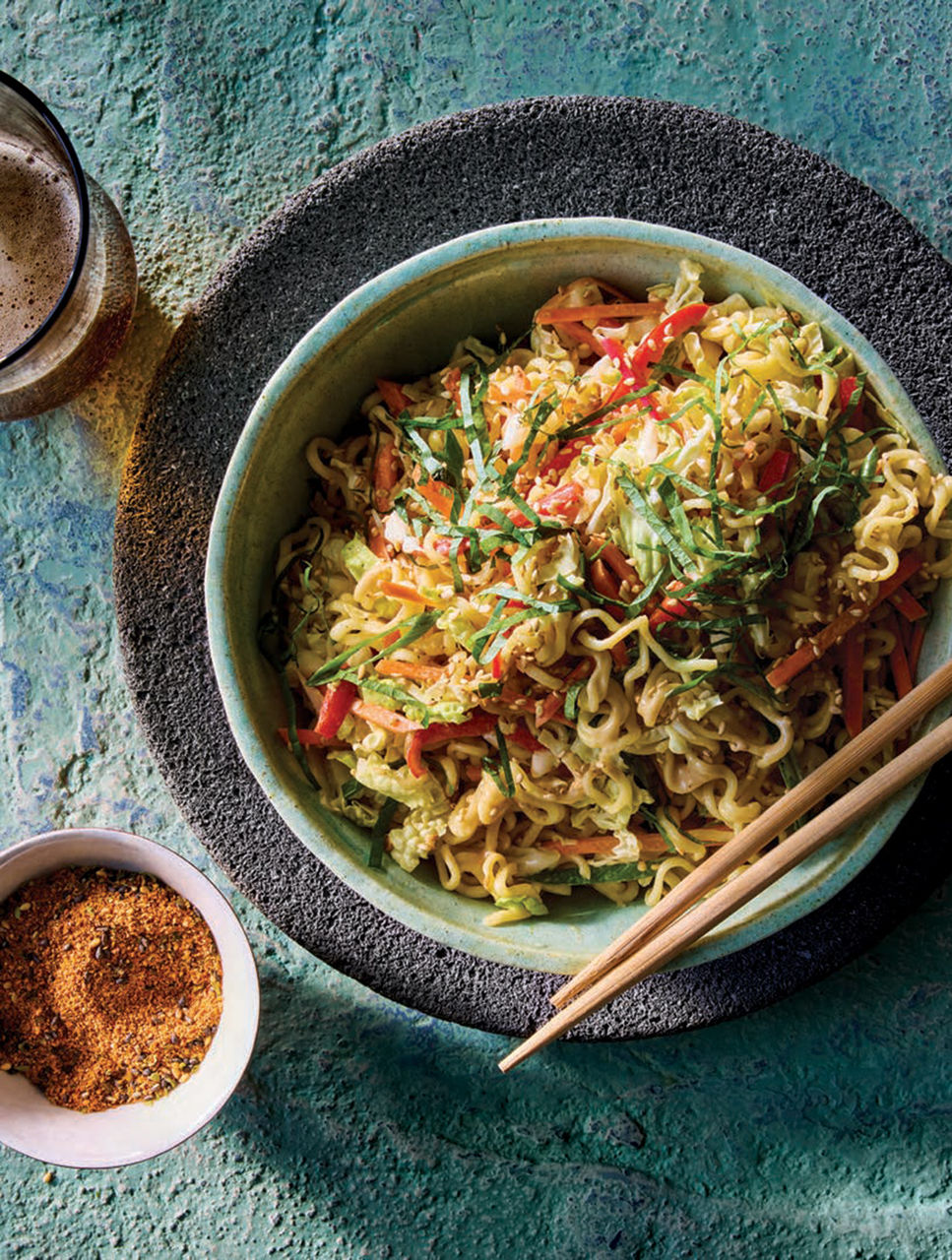
A mash-up of slaw and pasta salad, this vegan dish features instant ramen noodles and crunchy raw vegetables in a gingery, umami-packed dressing. An optional garnish of shiso or perilla leaves lends a uniquely herbal flavour. Togarashi is a Japanese spice blend that includes hot pepper, orange peel and sesame seeds. Shiso, perilla and togarashi can be found at select Asian supermarkets.
Ingredients:
Ginger Miso Dressing 2 tbsp (30 mL) chopped ginger 2 tbsp (30 mL) white miso 2 tbsp (30 mL) soy sauce 1 tbsp (15 mL) granulated sugar 1/4 cup (60 mL) rice vinegar 1/4 cup (60 mL) canola oil 2 tbsp (30 mL) sesame oil Salad 3 single-serve pkgs (100 to 120 g each) instant ramen noodles, flavour packets discarded or saved for another use 5 cups (1.25 L) packed thinly sliced Napa cabbage 1 red Shepherd or bell pepper, julienned 1 medium-size carrot, peeled, julienned 3 green onions, green parts only, thinly sliced on bias Salt to taste Roasted sesame seeds and finely sliced shiso or perilla (optional) to garnish Shichimi or Nanami togarashi to serve
Directions:
For the dressing, combine ginger, miso, soy, sugar and vinegar in blender. Blend until smooth. With motor running, add oils in a slow, steady stream until emulsified. Scrape down bowl and blend again. Transfer to an airtight container. Refrigerate up to 1 month. Stir before using.
Bring a large pot of lightly salted water to a boil. Add ramen and cook according to instructions on package. Drain and rinse under cold running water until cooled. Drain again and transfer to a very large mixing bowl. Blot excess moisture from ramen with paper towel.
Add cabbage, pepper, carrot and green onions to bowl. Season lightly with salt. Add enough dressing to coat, saving rest for another use. Using tongs, toss salad until well mixed.
Transfer to a serving bowl. Sprinkle with sesame seeds and top with shiso or perilla, if using. Serve with togarashi on the side. Serves 6 to 8
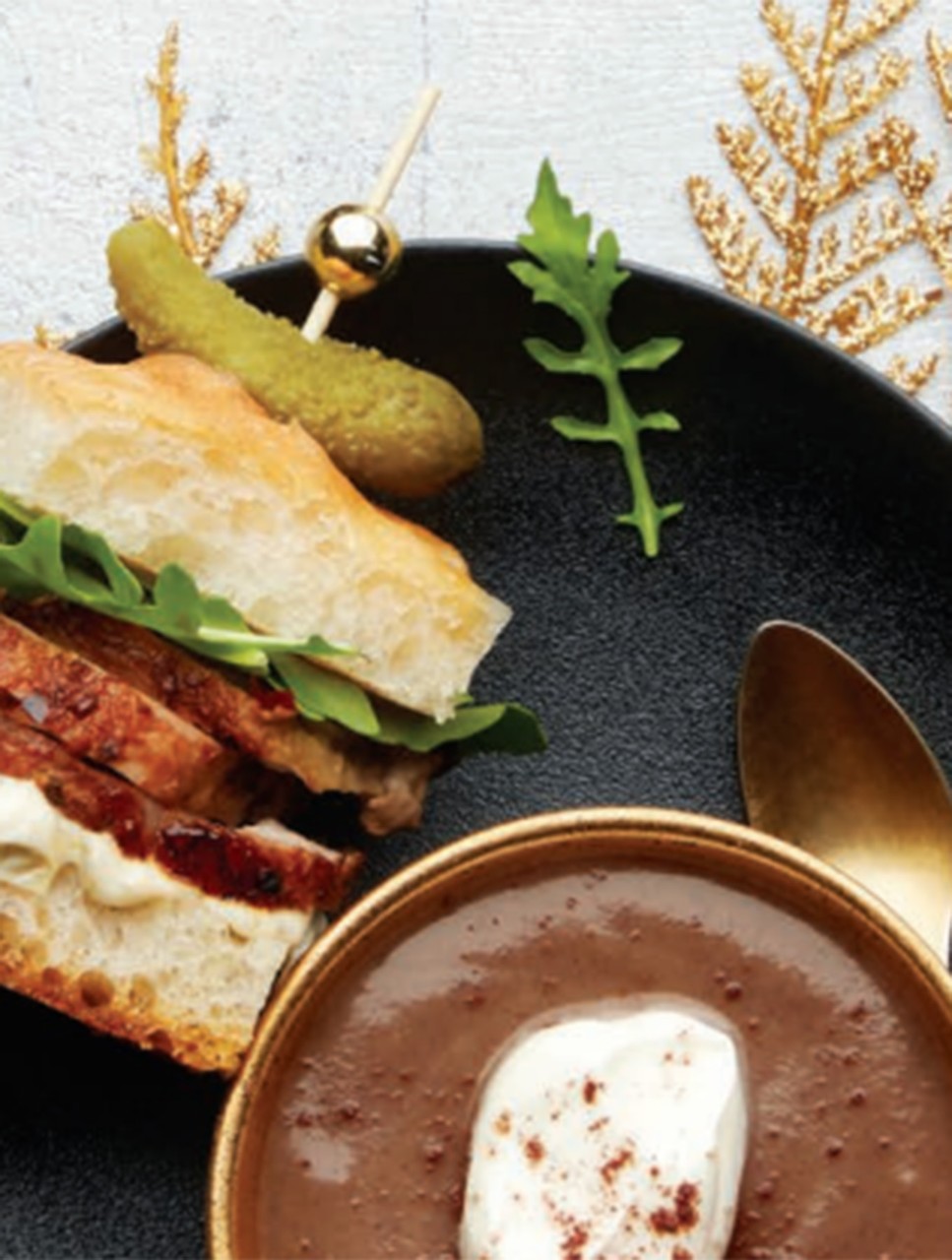
Moist homemade focaccia sandwiches with porchetta-spiced pork tenderloin, peppery arugula and a punchy caper mayo make a satisfying three-bite appetizer. If you want to save time, use small dinner rolls instead of making focaccia. The focaccia is an adaptation of Jim Lahey’s no-knead pizza dough, with the addition of olive oil and more yeast. Ingredients:
Focaccia 3 1/3 cups (830 mL) all-purpose flour 1 1/2 tsp (7 mL) fine sea salt 1 tsp (5 mL) instant yeast 5 tbsp (75 mL) extra virgin olive oil, divided 1 1/2 cups + 1 tbsp (375 + 15 mL) water, at room temperature Softened unsalted butter for greasing pan
Pork Two 1 lb (455 g) pork tenderloins, trimmed, cut in half crosswise Salt and freshly ground pepper to taste 2 tbsp (30 mL) extra virgin olive oil 2 cloves garlic, grated on rasp 2 tsp (10 mL) whole fennel seeds, coarsely ground 1 1/2 tsp (7 mL) finely chopped rosemary 1/2 tsp (1 mL) chilli flakes 1 tbsp (15 mL) canola oil
Mayonnaise 1 cup (250 mL) mayonnaise (reduced fat is fine) 1/4 cup (60 mL) capers, rinsed, dried, chopped 1 tsp (5 mL) fresh lemon juice Big handful washed baby arugula Toothpicks and cornichons for serving
Directions: For the focaccia, place flour, salt and yeast in a large mixing bowl. (Bowl should be big enough for the dough to quadruple in size.) With a sturdy wooden spoon, stir in 2 tbsp (30 mL) olive oil and water. With your hand or a pastry scraper, briefly knead the mixture in a bowl to achieve soft, shaggy and slightly sticky dough. Clean the sides of the bowl and cover tightly with plastic wrap. Let rise at cool room temperature for 16 to 24 hours.
Grease a 13 x 9-inch (33 x 23 cm) nonstick baking pan with butter. (This may seem excessive, but it will stick without it.) Pour in 2 tbsp (30 mL) olive oil, then scrape dough onto the pan. Rub top with remaining 1 tbsp (15 mL) olive oil. Press and pull the dough to fill the pan. Cover with plastic wrap and let proof at room temperature for 2 hours.
Preheat oven to 450°F (232°C).
Dimple dough firmly with fingertips, popping any air bubbles. Bake on the middle rack until puffed and golden, about 25 minutes. Remove from oven. Cool briefly before transferring to a cooling rack. Focaccia is best eaten the same day but to make in advance, wrap tightly in plastic wrap, place in a freezer bag and freeze up to 1 month.
For the pork, place tenderloins on a baking sheet. Season with salt and pepper. In a small bowl, mix olive oil, garlic, fennel, rosemary and chilli. Rub the paste all over the pork. Transfer pork to a freezer bag. Press out air, seal and refrigerate overnight.
Let pork sit at room temperature for 30 minutes. Preheat oven to 350°F (177°C).
Heat canola oil in a large nonstick frying pan over medium-high heat. Add pork. Cook, turning occasionally until nicely browned all over, 6 to 7 minutes in total. Transfer to a roasting pan fitted with a wire rack. Bake until an instant-read thermometer inserted in the thickest part reaches 140°F (60°C) for a medium, 20 to 23 minutes. Rest for at least 15 minutes before slicing. (If you are making it ahead, cool pork and wrap tightly in plastic wrap. Refrigerate for up to 3 days. Bring to room temperature before serving.)
When ready to serve, slice pork 1/3 inch (3 mm) thick. Cut focaccia into 24 even squares. Split focaccia squares in half. In a small bowl, mix mayo, capers and lemon juice. Smear focaccia bottoms generously with caper mayo. Top with pork slices and few arugula leaves. Affix focaccia tops with toothpicks and skewer cornichons on top. Makes 24 mini panini
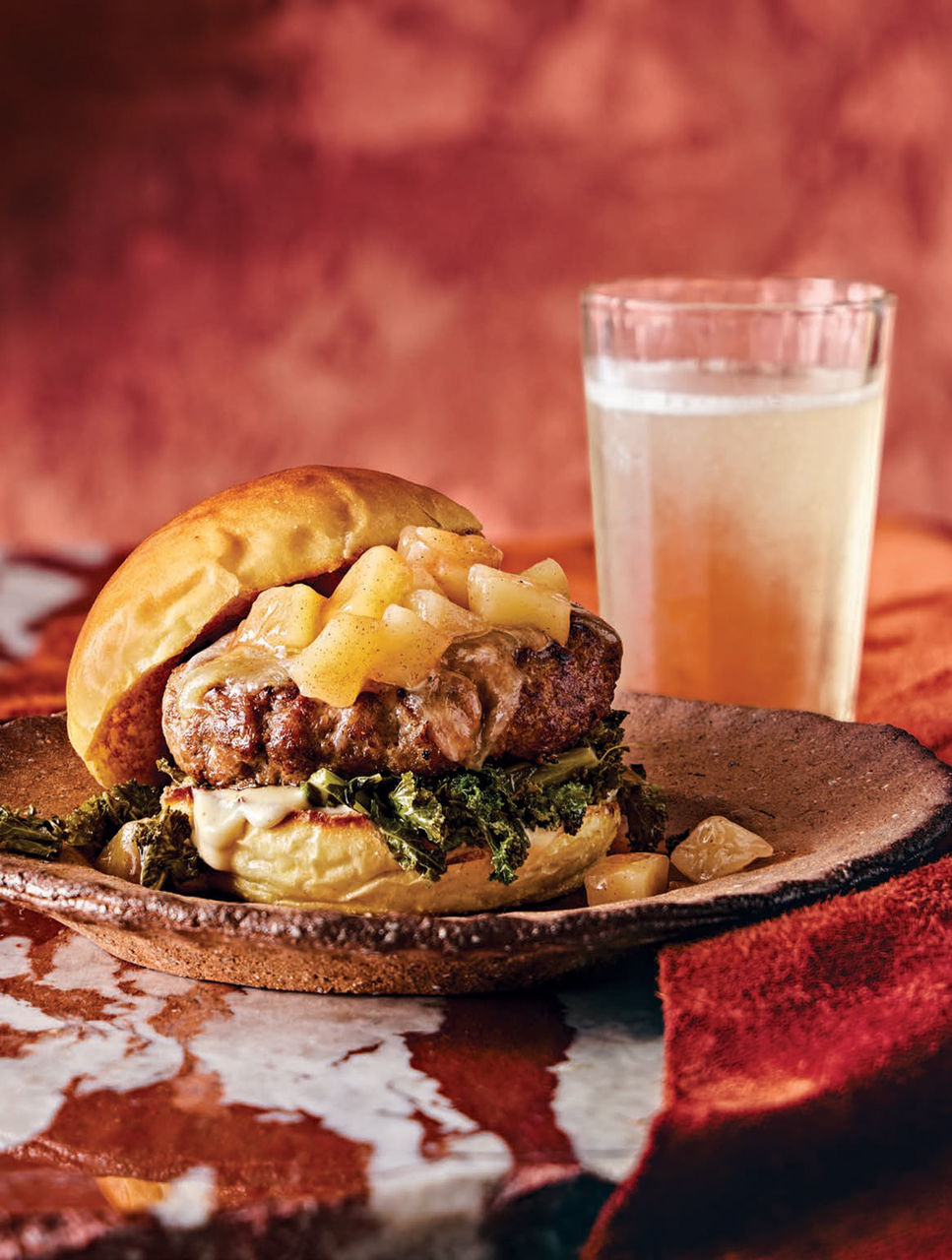
Meet your new favourite fall burger, featuring the unlikely marriage of pumpkin spice and ground pork. The juicy patty is accessorized with warm apple compote, sautéed kale, sharp cheddar and a mustardy maple mayo. If you don’t eat pork, you can swap in ground dark turkey meat. Ingredients:
Apple Compote 2 Royal Gala apples, peeled, cored, diced 1/3 cup (80 mL) water 1 tbsp (15 mL) fresh lemon juice 1 tbsp (15 mL) sugar 1 tsp (5 mL) pumpkin spice
Maple Mayo 1/2 cup (125 mL) mayonnaise 2 tsp (10 mL) maple syrup 1 tsp (5 mL) Dijon mustard Pinch black pepper
Burgers 2 tbsp (30 mL) unsalted butter 1/2 cup (125 mL) panko 2 tsp (10 mL) pumpkin spice 1 egg 1/2 tsp (2 mL) salt, plus more for seasoning 1 lb (455 g) ground pork 3 tbsp (45 mL) canola oil, divided 1 bunch curly kale, stems removed, thinly sliced 1 tbsp (15 mL) apple cider vinegar 4 brioche burger buns, split 4 large slices aged white cheddar
Directions: For the compote, combine apples, water, lemon juice, sugar and pumpkin spice in a small saucepan over medium heat. Cook, stirring occasionally, until apples are softened but not mushy, 15 to 20 minutes. Remove from heat. (Compote can be cooled, covered and refrigerated up to 1 week. Warm in microwave before using.)
For the maple mayo, place all ingredients in a small bowl. Whisk to combine. Cover and refrigerate up to 5 days.
For the burgers, melt butter in a large frying pan over medium heat. Add panko. Cook, stirring occasionally, until golden, about 5 minutes. Stir in pumpkin spice and toast until fragrant, about 30 seconds. Transfer to a large mixing bowl and cool completely. Stir egg and salt into panko. Add ground pork and mix until combined. Divide into four equal portions and shape into 1/2-inch (1-cm) thick patties. Cover and refrigerate until ready to use.
Wipe pan clean and return to medium heat. Add 2 tbsp (30 mL) oil then kale. Cook, stirring occasionally, until volume has reduced by three quarters, 5 to 7 minutes. Stir in vinegar and season with salt. Cook until vinegar has evaporated, about 30 seconds. Transfer mixture to a bowl.
Wipe skillet clean and place over medium-high heat. Add remaining 1 tbsp (15 mL) oil. Add patties and cook until nicely browned and cooked through, 4 to 6 minutes per side.
While burgers are cooking, toast buns. Spread maple mayo on bottoms then top with some kale (saving rest for another use), patties, apple compote, cheese and bun tops. Serves 4
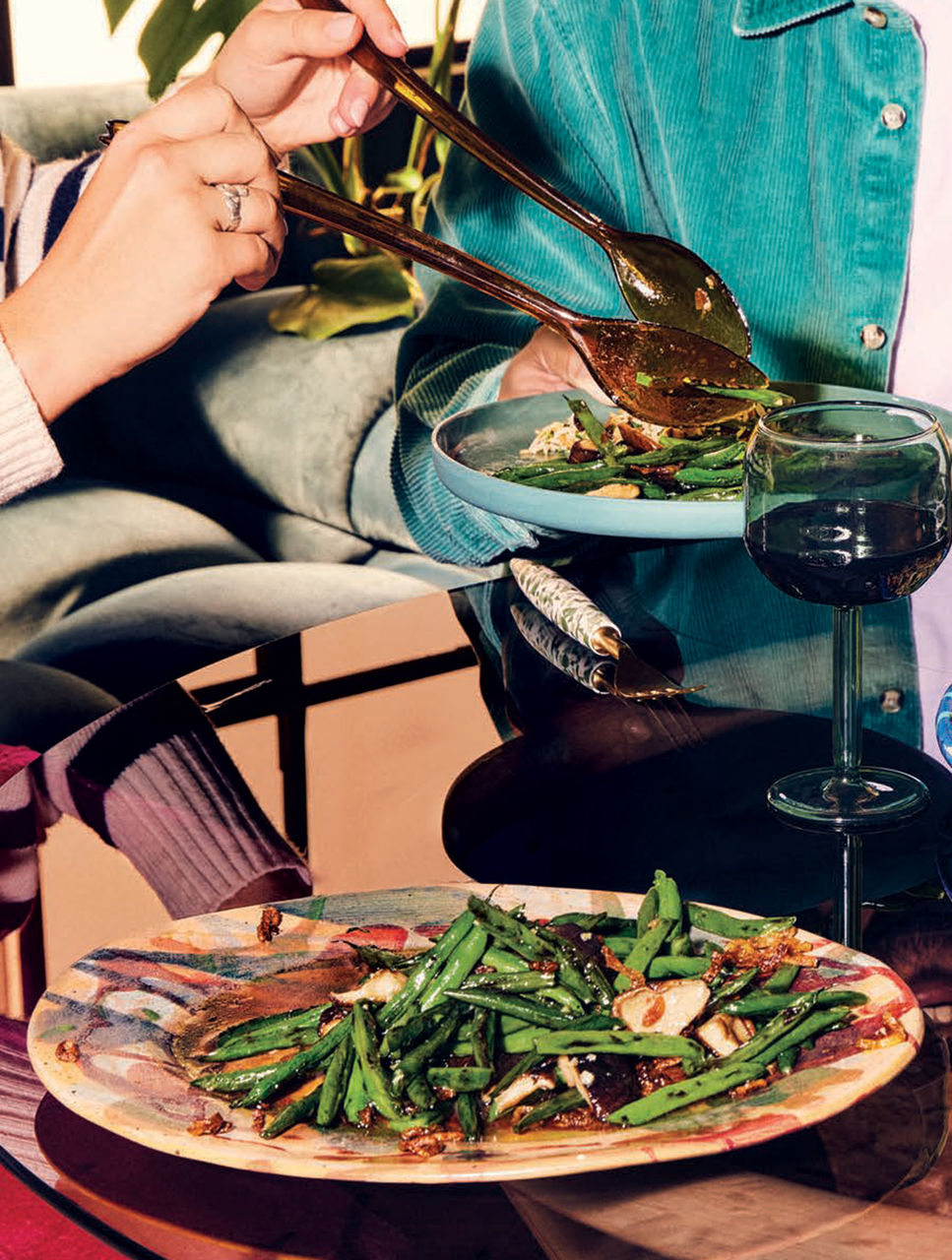
This dish has all the components of a classic green bean casserole, but it’s dressed in a zippy fish sauce caramel instead of cream of mushroom soup. The whole thing comes together fast—in a fraction of the time a casserole would take—so make sure you have everything ready to go before you start cooking. Serves 6 to 8 Ingredients: 1/4 cup (60 mL) granulated sugar 1/2 cup (125 mL) hot tap water 1/4 cup (60 mL) fish sauce 2 cloves garlic, minced 1 red bird’s-eye chili, halved (optional) 1/4 cup (60 mL) canola oil 2 small shallots, thinly sliced into rings 1/2 lb (225 g) shiitake mushrooms, stems discarded, caps halved or quartered 1 lb (455 g) green beans, trimmed, cut on bias into 2-inch (5-cm) pieces 1 lime, halved
Directions: Stir sugar with water until dissolved then add fish sauce, garlic and chili, if using. Set aside.
Set a fine-mesh strainer over a medium heatproof bowl.
Combine oil and shallots in a large frying pan. Heat over medium-high until shallots start to sizzle, then stir constantly until golden- brown, 6 to 8 minutes. Quickly remove pan from heat and strain shallots through prepared strainer.
Carefully return 1 to 2 tbsp (15 to 30 mL) strained oil to pan. Add mushrooms and cook, stirring often, until golden-brown, about 5 minutes. Transfer mushrooms to a large plate, then add green beans to pan. Cook, stirring often, until beans are bright green and slightly charred in places, 4 to 5 minutes.
Lower heat to medium and return mushrooms to pan. Carefully add fish sauce mixture—it will steam up immediately. Cook, stirring often, until sauce has thickened and beans are tender-crisp, 3 to 4 minutes. Transfer to a large serving platter. Squeeze lime juice overtop, then garnish with crispy shallots. Serves 6 to 8
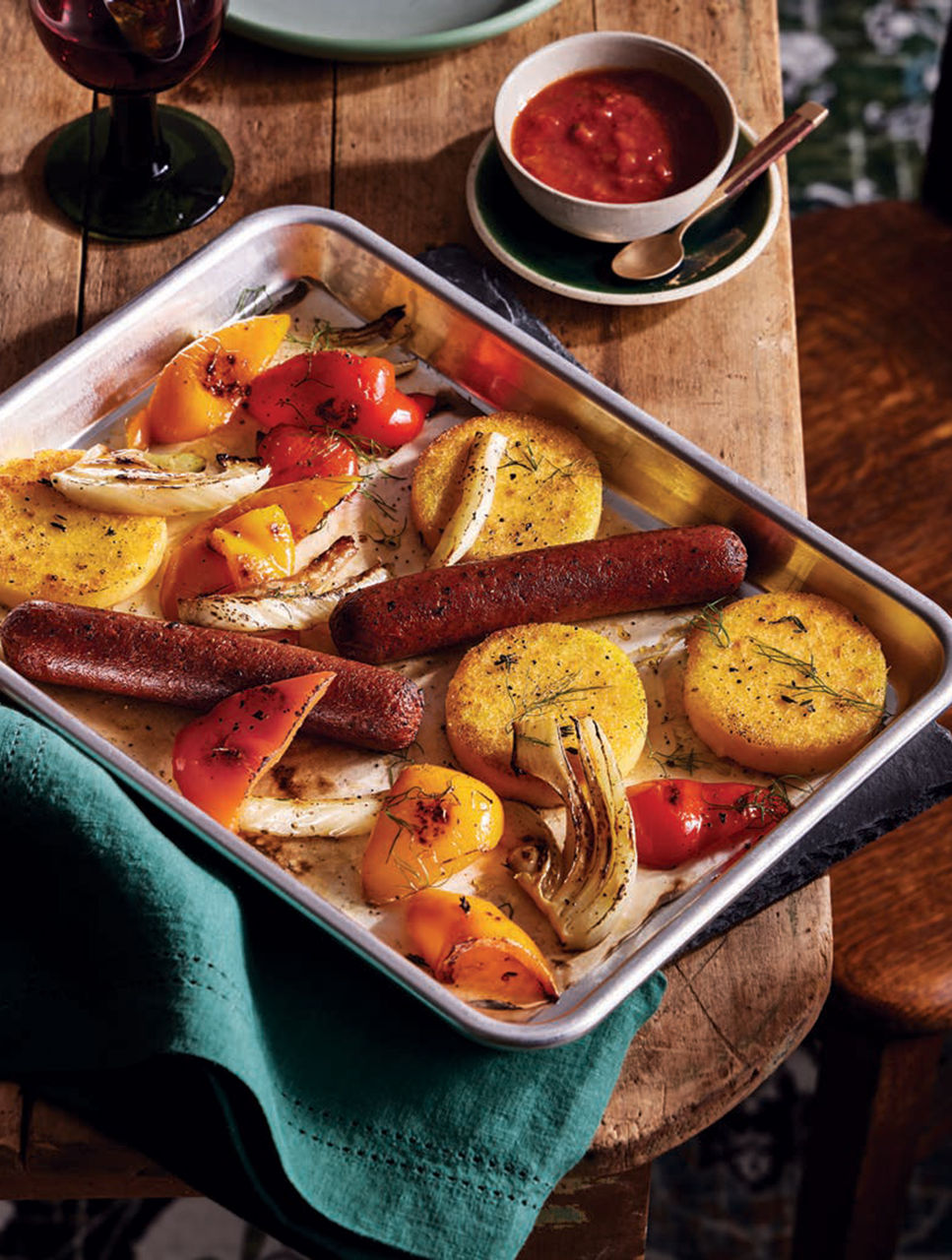
When you’re craving something spicy, here’s an easy, vegetarian sheet pan dinner of plant-based sausage, rounds of polenta, sweet peppers and fennel. If you’re a meat-eater, it’s just as delicious with an Italian or Mexican-style chorizo sausage. Serves 1 Ingredients: 1 tbsp (15 mL) canola oil, plus more for brushing 1 small red or orange bell pepper, roughly chopped 1/3 trimmed fennel bulb, sliced lengthwise 1/2 inch (1 cm) thick, long
ones cut in half Salt to taste 1/4 tube (250 g) ready-to-eat polenta, sliced into 4 rounds Large pinch dried leaf oregano 1 to 2 spicy plant-based sausages, depending on appetite 1/2 cup (125 mL) prepared marinara sauce Fennel fronds to garnish
Directions:
Preheat oven to 400°F (204°C). Line a baking sheet with foil or parchment paper. Brush with a little oil.
Place peppers and fennel in a bowl. Drizzle with 1 tbsp (15 mL) oil and season with salt. Toss to coat. Spread out in middle of baking sheet. Place polenta on sheet, brush with oil and sprinkle with oregano. Add sausage and brush with oil.
Roast until vegetables are tender, about 15 minutes. When almost ready to serve, microwave tomato sauce in a ramekin until hot.
Place polenta and sausage on plate. Stir vegetables and transfer to plate. Garnish with fennel fronds. Serve with tomato sauce.
Moroccan-style preserved lemons (and a bit of their brine) give this aïoli a depth of flavour you can’t get from fresh lemons. Look for them at gourmet food shops. Makes 1 1/2 cups (375 mL) Ingredients 2 large egg yolks 2 cloves garlic, grated 1 whole small preserved lemon, rinsed, seeded, chopped, about 4 tsp (20 mL) 1 tbsp (15 mL) fresh lemon juice 1 tbsp (15 mL) preserved lemon brine 1 1/4 cups (310 mL) canola oil Salt to taste Directions: In a food processor, combine egg yolks, garlic, preserved lemon, lemon juice and brine. Process until smooth and uniform. With motor running, add canola oil in a slow, steady stream until it is fully incorporated and emulsified. Taste and season with salt, if necessary. Transfer to an airtight container. Refrigerate up to 5 days.
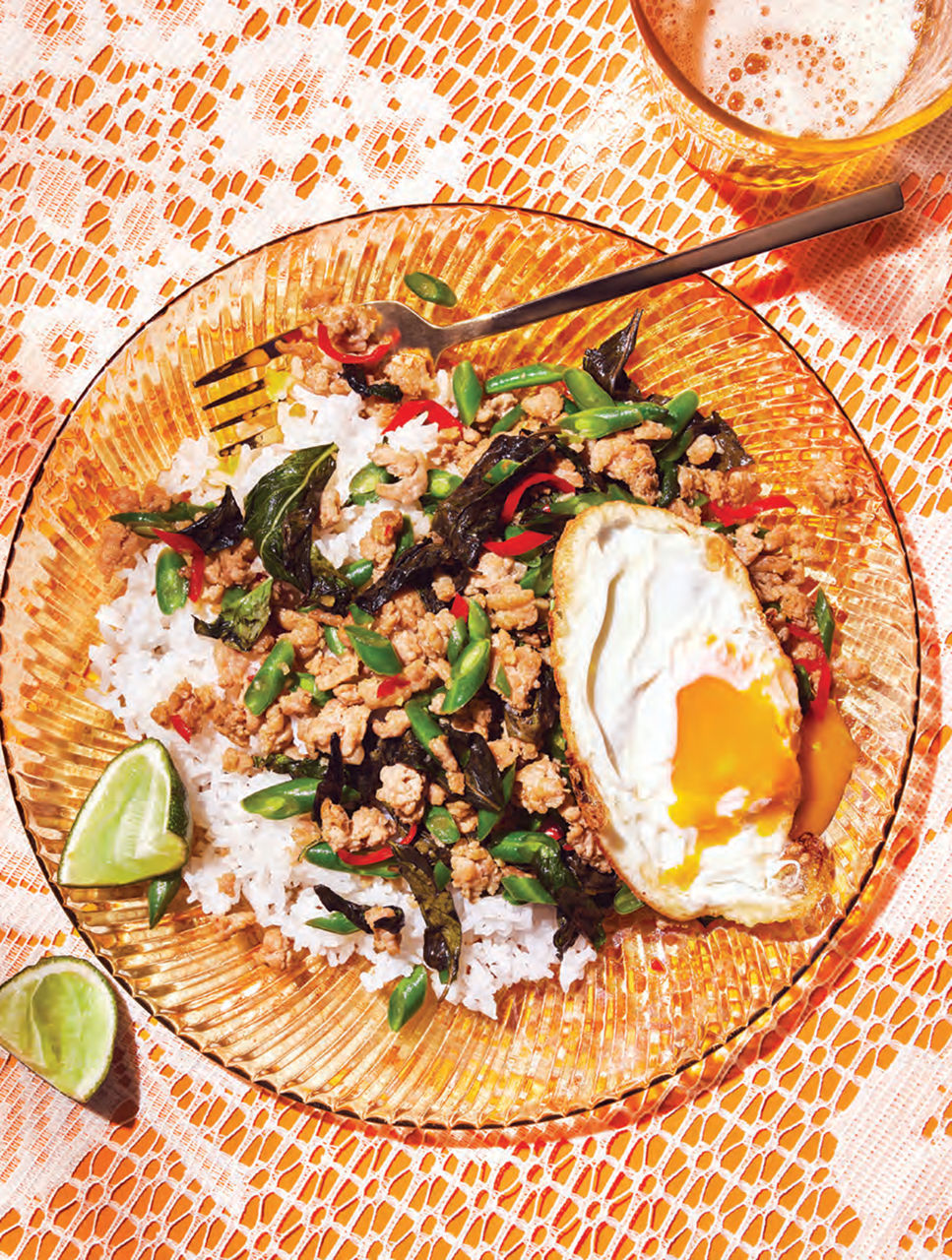
If your weeknight dinner repertoire doesn’t include Thai Basil Chicken (Pad Krapow Gai), then you’re missing out. This superquick stir-fry comes together faster than you could get takeout delivered. It traditionally uses holy basil, which is very hard to find, but you can use either Thai or sweet basil, depending on availability.
Ingredients: 2 tbsp (30 mL) fish sauce, preferably Thai 1 tbsp (15 mL) oyster sauce, preferably Thai 1 tbsp (15 mL) low-sodium soy sauce l tbsp (15 mL) water 1 tbsp (15 mL) brown sugar 6 tbsp (90 mL) canola oil, divided 1 lb (455 g) ground chicken 4 cloves garlic, minced 1 red bird’s-eye chili, finely chopped 1 long red chili, halved, seeded, thinly sliced 7 oz (200 g) green beans, cut on bias into 1/4-inch (5-mm) pieces 1 1/2 cups (375 mL) loosely packed basil leaves, preferably Thai 4 large eggs Jasmine rice and lime wedges for serving
Directions: Stir fish, oyster and soy sauces with water and brown sugar in a small bowl. Set aside.
Heat 3 tbsp (45 mL) oil in a large nonstick frying pan over high heat until shimmering. Add chicken and cook, breaking up meat with a wooden spoon, until liquid has evaporated and chicken is starting to sizzle and brown, 5 to 7 minutes.
Reduce heat to medium and add garlic and chilies. Cook, stirring constantly, until fragrant, about 30 seconds. Add green beans and fish sauce mixture. Stir constantly until sauce evenly coats chicken, about 1 minute. Remove from heat and stir in basil. Cover and set aside.
Heat remaining 3 tbsp (45 mL) oil in a small nonstick pan over medium-high. Cook eggs, one at a time, until edges are browned, whites are puffed and yolks are still runny, about 1 minute. (Be careful as oil tends to pop a bit.)
Serve stir-fry with steamed jasmine rice, lime wedges and a fried egg on top of each serving. Serves 4
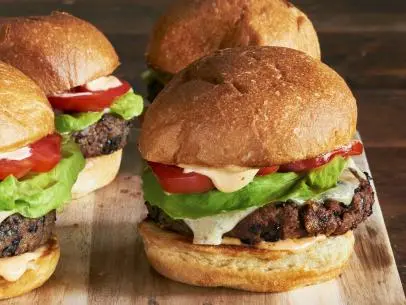
2 cups black beans, drained and mashed with a fork. 1 cup seasoned bread crumbs
1/4 cup grated onion 1/2 teaspoon chili powder 1 egg S&P Canola oil for grilling pan 1 to 2 Kaiser rolls Arugula for serving Mayonnaise for serving Sliced tomatoes for serving
Directions: Mix together the beans, breadcrumbs, onions, chili powder, egg and some salt and pepper in a medium bowl. Form the mixture into 1 big (or 2 smaller) patties.Preheat a grill pan over medium-high heat and add some canola oil. Cook the burger 4 minutes per side. Serve on a kaiser roll with arugula, tomato slices and mayo.
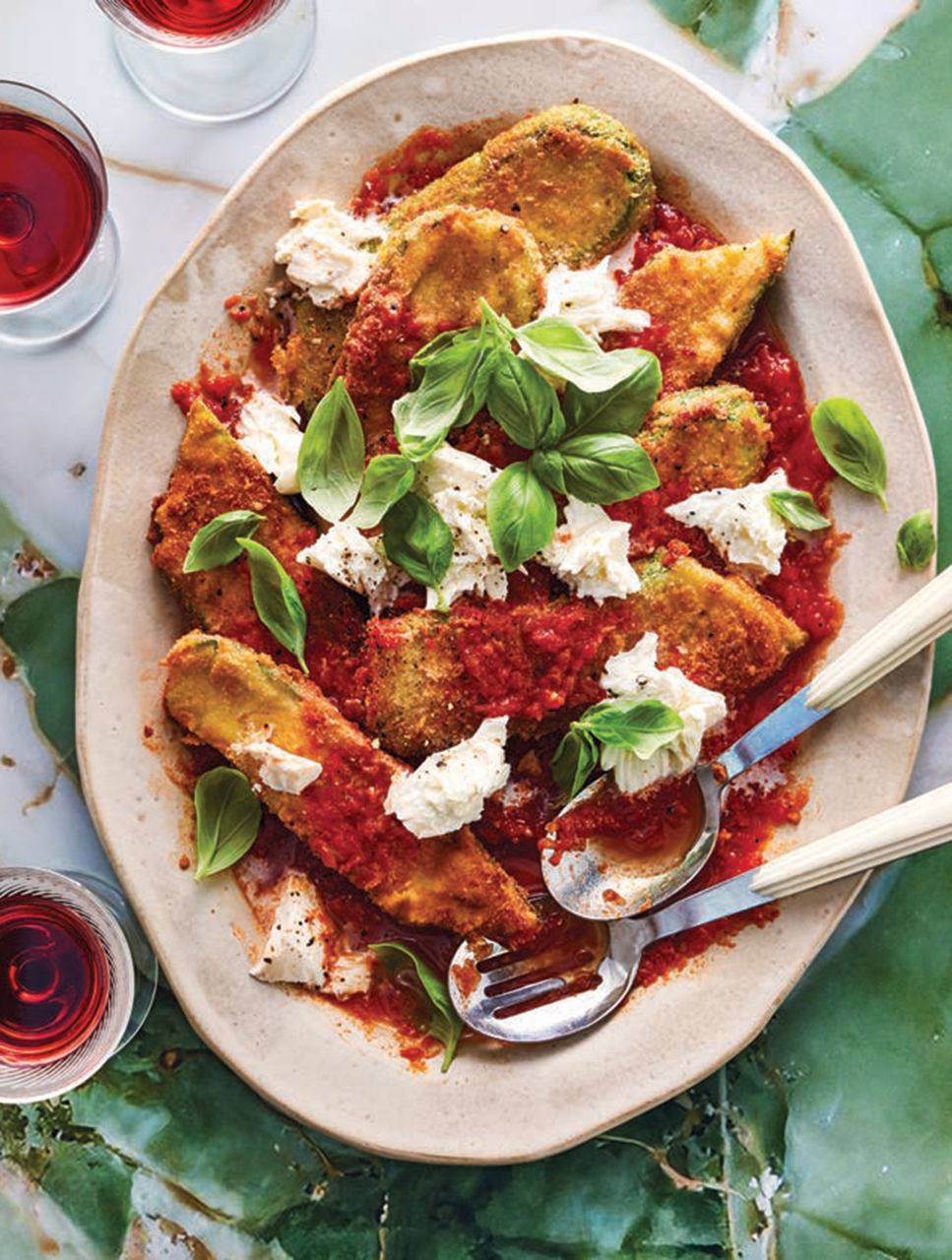
This fresh, warm-weather take on the classic casserole uses heirloom Romanesco zucchini and sweet Roma tomatoes to highlight the best of the season. The zucchini is quickly salted to draw out excess moisture, allowing the breading to cling better and crisp up beautifully when fried. Romanesco zucchinis are distinguished by the telltale ribbing that runs lengthwise along the fruit.
Ingredients:
Roma Tomato Sauce
2 1/2 lbs (1.13 kg) Roma (plum) tomatoes, halved widthwise2 tbsp (30 mL) extra virgin olive oil
2 large garlic cloves, smashed, thinly slice
2 tbsp (30 mL) tomato paste
2 large basil sprigs
Salt and freshly ground pepper to taste
Zucchini Cutlets
2 medium Romanesco or green zucchini, each about 12 oz
350 gr. trimmed
Salt and freshly ground pepper to taste
3/4 cup (175 mL) all-purpose flour
3 large eggs
1 1/2 cups (375 mL) dried breadcrumbs
1/4 cup (60 mL) finely grated Parmesan
3/4 cup (175 mL) canola oil
1 ball (125 g) fresh mozzarella, torn into bite-size pieces
Basil leaves to garnish
Directions: For the tomato sauce, coarsely grate tomato flesh into a large bowl. (Discard skins or save for vegetable stock.) You should have about 4 cups (1 L) pulp. Set aside.
Heat oil in a large pot over medium-low heat. Add garlic. Cook, stirring often, until garlic is soft and fragrant, 2 to 3 minutes. Add tomato paste and cook, stirring constantly, for 2 minutes. Stir in tomato pulp and basil. Season with salt and pepper. Bring to a boil, then reduce heat to medium-low to maintain a simmer. Cook, stirring occasionally, until mixture is saucy and reduced to about 3 cups (750 mL), 25 to 30 minutes. Adjust seasoning, if necessary. Discard basil.
For the cutlets, working lengthwise, thinly trim two edges of zucchini to flatten surfaces. Save for another use. Slice zucchini in same direction, into 1/2-inch (1-cm) thick slices—you should have about eight slices total. Cut each slice crosswise in half on bias. Transfer to a large, rimmed baking sheet. Season both sides generously with salt. Arrange in an even layer and let stand until liquid is released, 25 to 30 minutes.
Place flour in a shallow dish. Season with pepper. In another shallow dish, whisk eggs. In a third shallow dish, combine breadcrumbs and Parmesan.
Set a wire rack on countertop. Shake off excess liquid from zucchini, then pat dry on paper towel, firmly pressing to remove as much liquid as possible. Working with one slice at a time, dredge zucchini in flour mixture, turning to coat. Shake off any excess, then dip into egg mixture. Let excess drain back into the dish, then dip into breadcrumb mixture, patting to coat fully. Transfer to wire rack and repeat with remaining zucchini.
Heat oil in a large, deep skillet over medium-high heat. Working in batches, cook zucchini, flipping halfway through, until deeply golden brown, 2 to 3 minutes per side. Transfer with tongs to a clean wire rack set over a baking sheet.
Rewarm tomato sauce over medium heat. Spread three quarters of sauce over the bottom of a large platter. Arrange zucchini overtop. Spoon remaining sauce over zucchini. Top with mozzarella. Season with pepper and garnish with basil. Serve immediately. Serve with Rose Wine
Mothers Day 2007 was the inception of the blog, Dine With Donna. I enjoy the challenge of preparing a variety of foods. Growing up in a large Catholic family in the Midwest, my cooking skills were inspired as my mother's kitchen assistant. If you choose to use a recipe, please post a comment or suggestion that will help another person coming to the blog.


:max_bytes(150000):strip_icc()/Oxtail-soup-FT-RECIPE0424-001136ec7bf249fa92aa72cb2f220bcd.jpeg)